Nexus Prima Journal — Version 1.0
Nexus Prima is an organisation dedicated to advancing humanity’s next chapter through interdisciplinary research, technological development and long-term thinking.
The challenges humanity will face in the coming decades cannot be understood through a single discipline. Nexus Prima therefore approaches important questions from multiple perspectives before synthesising them into a broader framework.
This article is the first study published in the Nexus Prima Journal.
Why Mars?
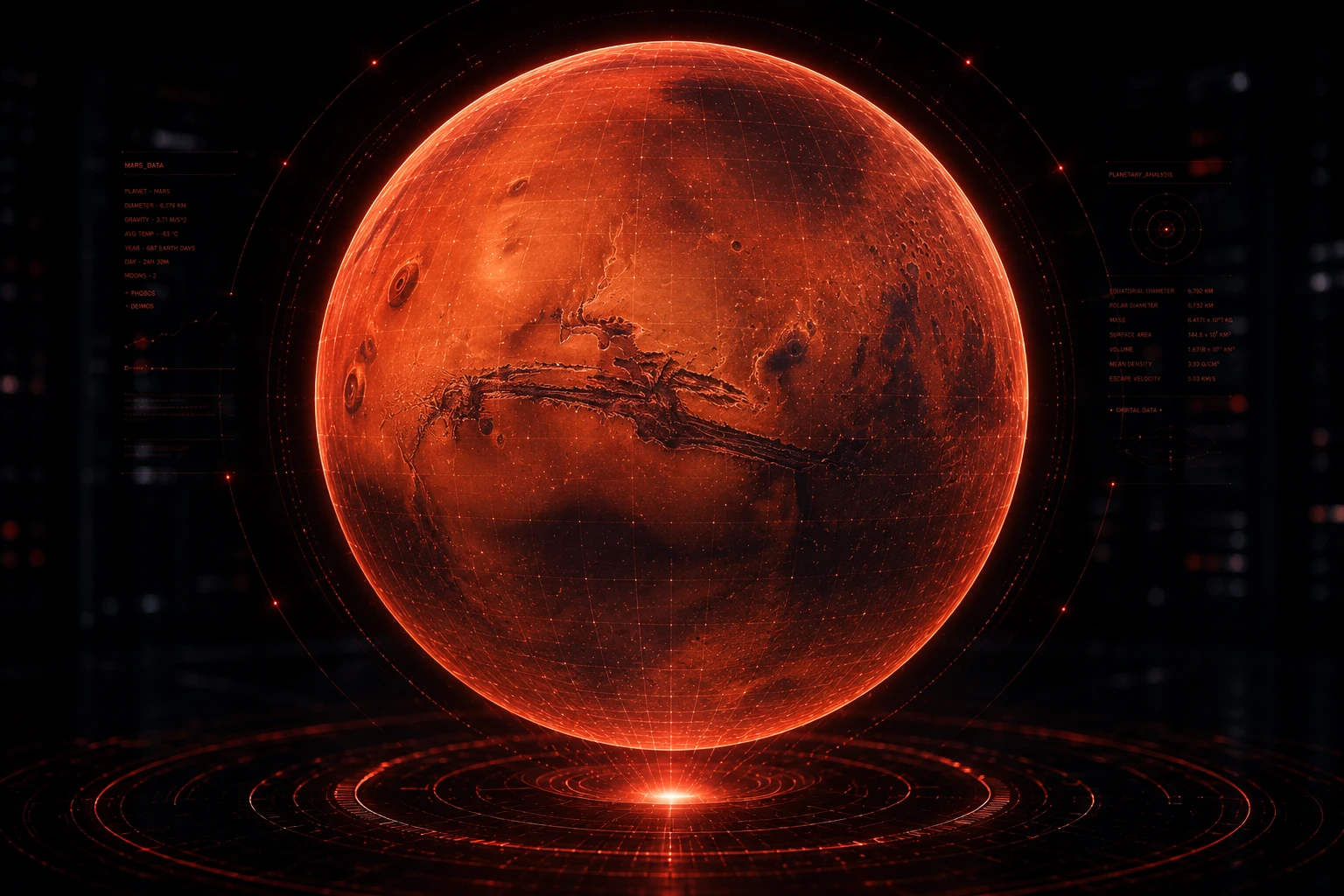
Mars represents one of humanity’s most ambitious projects.
The Mars Society argues that Mars is singular among planetary bodies because it possesses the raw materials required to support life and, potentially, “a new branch of human civilization” (The Mars Society, 2015).
NASA describes Mars as the fourth planet from the Sun and one of Earth’s two closest planetary neighbours. It also calls Mars “a rich destination for scientific discovery and a driver of technologies that will enable humans to travel and explore far from Earth” (NASA, 2026a; NASA, 2026b).
For the first time in history, our species is seriously preparing to establish a permanent presence on another world. Governments, private companies and researchers are already developing habitats, transportation systems, life-support technologies and plans for future settlements.
Yet one fundamental question remains insufficiently explored:
What is a city, and at what point does a settlement become one?
A habitat protects people.
A base supports missions.
A settlement enables permanent residence.
But a city represents something fundamentally different. It is not merely a collection of buildings or infrastructure. It is a place where society—and eventually civilisation—begins to emerge.
Understanding this distinction may influence how humanity designs its future beyond Earth.
SpaceX argues that establishing a permanent presence on Mars will require new technologies and industries involving power generation, resource extraction, propellant production, construction, communications and transportation. Established launch and landing sites—spaceports—would enable mobility and return capability to Earth (SpaceX, n.d.).
This study therefore asks:
What conditions must exist before humanity can call the first settlement on Mars a true city?
The question is examined through six complementary perspectives:
Engineering, Urban Planning, Economics, Sociology, Governance and History.
The objective is not simply to define a Martian city, but to understand the conditions under which a new civilisation could emerge.
Engineering
Engineering focuses on designing systems capable of supporting reliable, long-term human habitation.
On Mars, this includes life-support technologies, energy production, transportation, resource utilisation and resilient infrastructure.
A settlement would need to provide oxygen, water, food, shelter, energy, waste management and protection from radiation and extreme environmental conditions. These systems could not operate independently: the failure of one could threaten the survival of the entire settlement.
Robert Zubrin has argued that permanent human settlement on Mars will depend heavily on using local resources. Rather than transporting every necessary material from Earth, settlers would need to produce essential consumables, fuels and construction materials on Mars itself (Zubrin and Wagner, 1996).
Engineering therefore establishes the physical conditions for survival.
However, survival alone does not create a city.
Urban Planning
During the earliest missions, separating functions into isolated modules may improve operational safety. As the settlement grows, however, residential, scientific, commercial and social spaces will need to become increasingly integrated.
Cities exist for people.
In The Death and Life of Great American Cities, Jane Jacobs emphasised diversity, mixed uses, walkable streets and the importance of everyday interactions between people and their built environment. Her work challenged urban planning that separated activities too rigidly or treated cities as static machines rather than forms of organised complexity (Jacobs, 1961).
This raises an important question:
Can a Martian city exist if everyone moves exclusively through isolated tunnels without meaningful public interaction?
Kevin Lynch introduced another important concept: imageability.
In The Image of the City, Lynch explored how people form mental maps of the places in which they live. These maps are shaped by paths, edges, districts, nodes and landmarks (Lynch, 1960).
A Martian city should therefore do more than function efficiently. It should possess a recognisable identity that allows residents to orient themselves, remember places and develop an emotional attachment to their environment.
Cities on Earth evolved over centuries.
A Martian settlement will not have that luxury.
Its planners must anticipate future expansion while preserving enough flexibility to adapt to technological, demographic and environmental change.
Urban-planning literature therefore suggests that cities are more than engineered infrastructures. They are environments designed to facilitate movement, interaction, identity and adaptation.
Engineering enables human survival.
Urban planning shapes the conditions under which survival can become urban life.
Economics
Economics helps explain why cities emerge, grow and persist.
Cities are not only places where people live. They are also places where economic activity becomes concentrated because proximity creates advantages.
From a Martian perspective, economics asks whether a settlement can become increasingly self-sustaining rather than remaining permanently dependent on Earth.
Paul Krugman’s work on economic geography formalised the idea that firms, workers and services benefit from being located close to one another. Alfred Marshall had previously observed similar effects in industrial clusters (Marshall, 1890; Krugman, 1991).
Firms cluster together.
Workers cluster together.
Services cluster together.
Proximity can reduce costs, increase productivity, facilitate exchange and accelerate the circulation of knowledge.
A Martian city cannot rely indefinitely on disconnected facilities. As industries, laboratories, services and research centres concentrate, they can generate advantages that support further development.
Edward Glaeser extends this idea by presenting cities as engines of innovation, economic growth and intellectual exchange. When people with different abilities and knowledge interact, ideas spread and new opportunities emerge (Glaeser, 2011).
Cities also enable the specialisation and division of labour.
Instead of every resident performing the same survival tasks, people gradually become engineers, doctors, scientists, teachers, technicians, entrepreneurs and specialists in other fields.
A settlement in which everyone performs nearly identical tasks may remain a survival outpost. A city requires a more diverse and productive social economy.
It also requires local production.
Every kilogram transported from Earth demands substantial energy, infrastructure and expense. Local manufacturing, food production, construction, maintenance and recycling therefore become economically necessary.
The central economic test is simple:
Could the settlement survive if Earth temporarily stopped sending supplies?
Economic theory suggests that cities emerge because concentration creates advantages in production, specialisation and exchange.
A Martian settlement becomes a city not merely by increasing its population, but by developing an economy capable of sustaining long-term activity and growth.
Sociology
Sociology asks what transforms a population into a society.
Max Weber treated the city not merely as a physical concentration of buildings and people, but as a social and institutional form. Individuals cooperate through markets, institutions, shared norms and collective life (Weber, 1958).
A Martian settlement therefore begins to resemble a city when it develops stable social relationships that extend beyond the objectives of the original mission.
Every city requires institutions.
These may include schools, hospitals, courts, scientific organisations, businesses and voluntary associations. Institutions organise collective life and allow communities to function beyond the decisions of individual leaders.
Trust and cooperation are equally essential.
A Martian city could survive only if people shared resources, followed common rules, resolved conflicts and helped one another. Without trust, even highly advanced technology could eventually fail.
Collective identity would also develop over time.
“I work on Mars.”
“I am a Martian citizen.”
Sociology suggests that a city is ultimately defined not only by its infrastructure or economy, but by the relationships connecting its inhabitants.
A Martian settlement becomes a true city when its population develops institutions, cooperation and a shared civic identity capable of sustaining life across generations.
Governance
Governance determines whether a settlement can coordinate collective life over time.
In Governing the Commons, Elinor Ostrom demonstrated that communities can create durable institutions for managing shared resources without relying exclusively on either centralised authority or private ownership (Ostrom, 1990).
This is particularly relevant to Mars because a Martian settlement would depend upon shared resources:
- oxygen;
- water;
- energy;
- food;
- habitable space.
Without effective governance, inhabitants may compete for these resources. With trusted institutions and legitimate rules, they can coordinate their use.
Residents must understand:
- who has the authority to make decisions;
- who is responsible for essential systems;
- how resources are allocated;
- how disagreements are resolved;
- how leaders can be held accountable.
Clear and legitimate rules reduce uncertainty and create stability.
Internationally, early Martian settlements would also operate within the framework of the 1967 Outer Space Treaty. The treaty prohibits national appropriation of celestial bodies and assigns responsibility to states for national space activities, including those conducted by non-governmental entities. Those activities require authorisation and continuing supervision by the relevant state. Although the treaty establishes broad legal principles, it leaves many questions concerning local governance, citizenship and political institutions unresolved (United Nations Office for Outer Space Affairs, 1967).
Governance therefore suggests that a Martian city depends not only on technological infrastructure, but also on institutions capable of coordinating shared resources, resolving conflict and adapting to changing circumstances.
Sustainable governance transforms a collection of settlers into a stable and enduring political community.
History
History reveals recurring patterns in how settlements emerge, develop and decline.
Cities have appeared under very different conditions, yet many have experienced similar challenges. Mesopotamian cities, Athens, Rome, Paris, London, New York and Singapore all developed through combinations of geography, institutions, economic activity, political organisation and adaptation.
Jared Diamond’s work on societal collapse presents one possible historical lens: civilisations become vulnerable when they fail to respond effectively to environmental and resource constraints (Diamond, 2005).
Mars represents an extreme version of this challenge.
A Martian city would need to adapt continuously or risk collapse.
Lewis Mumford’s The City in History also demonstrates that cities evolve rather than appearing fully formed. They develop through the interaction of physical structures, institutions, culture and human needs (Mumford, 1961).
Historical analogues such as Antarctic research stations, isolated islands, frontier settlements and early colonies cannot perfectly represent Mars. They can nevertheless illuminate recurring problems involving logistics, governance, isolation, dependence and adaptation.
History repeatedly shows that successful societies adapt, innovate and reorganise.
Those that fail to adapt become vulnerable to decline.
History does not predict the future, but it reveals recurring patterns in how human settlements emerge, grow and disappear. By studying previous civilisations, humanity may design Martian settlements that avoid historical failures while building upon centuries of accumulated experience.
Synthesis: When Does a Settlement Become a City?
Complex systems cannot be understood by examining every component in isolation. Their elements interact, creating effects that no single discipline can fully explain.
The same principle applies to a Martian city.
Engineering builds habitats.
Urban planning organises space.
Economics creates opportunity.
Sociology creates community.
Governance creates stability.
History teaches adaptation.
Together, these disciplines do not directly build a city.
They create the conditions under which a city can emerge.
A Martian city would therefore be more than an engineering project. It would be a civilisational system composed of interconnected technologies, institutions, relationships and environments.
Its success would not depend only on whether it possessed the best technology. It would depend on whether engineering, economics, governance, urban planning, sociology and historical knowledge could be integrated into one coherent system.
A city also emerges over generations.
The first settlers may build its habitats and institutions, but future residents will transform those structures through their own choices, relationships and culture. The goal should not be to design every element of the final city in advance, but to design systems that allow its inhabitants to shape and improve it themselves.
This leads to a deeper question.
How should children born on Mars be educated? What institutions, identity and culture would form around the first generation that had never lived on Earth?
Research into human reproduction beyond Earth highlights conception, gestation and birth as unresolved scientific and medical challenges. Childbirth would therefore represent one of the ultimate tests of whether an extraterrestrial settlement could become truly independent and multigenerational (Jain et al., 2023).
A city may therefore not be defined merely by the arrival of its first settlers.
It may begin to become a city when its first generation is born with the possibility of calling it home.
Mars City is not intended to replace civilisation on Earth. Its purpose would be to provide humanity with an additional source of resilience, scientific discovery and long-term possibility.
As Konstantin Tsiolkovsky wrote in a 1911 letter:
“Earth is the cradle of humanity, but one cannot live in the cradle forever.”
The wording varies slightly between English translations (Tsiolkovsky, 1911, as cited by the European Space Agency, n.d.).
This publication marks the first step in Nexus Prima’s continuing research into the systems that may shape humanity’s future.
Thank you for reading.
Mars City — Version 1.0
Nexus Prima
References
- Diamond, J. (2005). Collapse: How Societies Choose to Fail or Succeed. New York: Viking. Source ↗
- European Space Agency. (n.d.). “Konstantin Tsiolkovsky.” Accessed 25 July 2026. Source ↗
- Glaeser, E. L. (2011). Triumph of the City: How Our Greatest Invention Makes Us Richer, Smarter, Greener, Healthier, and Happier. New York: Penguin Press. Source ↗
- Jacobs, J. (1961). The Death and Life of Great American Cities. New York: Random House. Source ↗
- Jain, V., Chuva de Sousa Lopes, S. M., Benotmane, M. A., Verratti, V., Mitchell, R. T. and Stukenborg, J.-B. (2023). “Human Development and Reproduction in Space—A European Perspective.” npj Microgravity, 9, Article 24. doi: 10.1038/s41526-023-00272-5. Source ↗
- Krugman, P. (1991). “Increasing Returns and Economic Geography.” Journal of Political Economy, 99(3), pp. 483–499. doi: 10.1086/261763. Source ↗
- Lynch, K. (1960). The Image of the City. Cambridge, Massachusetts: MIT Press. Source ↗
- Marshall, A. (1890). Principles of Economics. London: Macmillan and Company. Source ↗
- Mumford, L. (1961). The City in History: Its Origins, Its Transformations, and Its Prospects. New York: Harcourt, Brace & World. Source ↗
- NASA. (2026a). “Mars.” NASA Science. Accessed 25 July 2026. Source ↗
- NASA. (2026b). “Humans to Mars.” Accessed 25 July 2026. Source ↗
- Ostrom, E. (1990). Governing the Commons: The Evolution of Institutions for Collective Action. Cambridge: Cambridge University Press. doi: 10.1017/CBO9780511807763. Source ↗
- SpaceX. (n.d.). “Mars.” Accessed 25 July 2026. Source ↗
- The Mars Society. (2015). “Why Mars?” 17 November 2015. Source ↗
- United Nations Office for Outer Space Affairs. (1967). Treaty on Principles Governing the Activities of States in the Exploration and Use of Outer Space, Including the Moon and Other Celestial Bodies. Source ↗
- Weber, M. (1958). The City. Translated and edited by Don Martindale and Gertrud Neuwirth. New York: Free Press. Source ↗
- Zubrin, R., with Wagner, R. (1996). The Case for Mars: The Plan to Settle the Red Planet and Why We Must. New York: Free Press. Source ↗